WHAT WE DO
Mold Remediation in Omaha, Lincoln & Council Bluffs
Mold needs three things: moisture, something to feed on, and time. Drywall paper, wood framing, carpet backing, and the dust in a basement give it plenty to eat, so the deciding factor is almost always water. That is why mold remediation is really two jobs: removing the growth you can see and the growth you cannot, and fixing the moisture problem that caused it. Skip the second part and the mold comes back.
We handle mold remediation for homes and businesses from our Omaha shop on South 22nd Street and our Lincoln location on North 33rd Street. Call (402) 543-3701 to schedule an inspection.
Where we find mold in Nebraska homes
- Basements. Concrete walls stay cool, and humid summer air condenses on them. Add a slow foundation leak or a past flood that was never fully dried, and the back of finished drywall becomes the most common place we find mold in the Omaha metro and Lincoln.
- Attics. Bathroom exhaust fans vented into the attic instead of outside, along with poor attic ventilation, leave frost on roof sheathing in winter. When it melts, the wood stays damp.
- Crawlspaces. Bare soil releases moisture constantly. Older homes in neighborhoods like Florence and Field Club in Omaha, or University Place in Lincoln, often have crawlspaces without a vapor barrier.
- Behind and under appliances. Dishwashers, refrigerator ice-maker lines, and washing machines leak slowly for months before anyone notices.
- After a water loss that was not fully dried. If a past leak was cleaned up with fans and a shop vac, the wall cavity may still be wet. Our water damage restoration process is built to prevent exactly this.
Signs you may have a mold problem
A musty, earthy smell that is stronger in one room or when the HVAC kicks on. Dark spotting on drywall, baseboards, or ceiling corners. Peeling paint or bubbling wallpaper. Warped baseboards. A history of leaks or flooding in the same area. You do not always see mold, so smell and moisture history matter as much as what is on the surface.
How we remediate mold
1. Inspection and moisture source. We use moisture meters and thermal imaging to map how far the problem extends and to find the water source. If the source is a plumbing leak, a grading issue, or a vent problem, we tell you so it can be fixed.
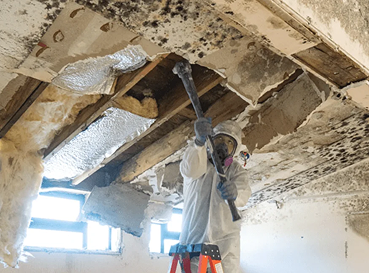
2. Containment. Plastic sheeting and negative air pressure with HEPA filtration keep mold spores from spreading into the rest of the house while we work.
3. Removal. Porous materials with growth, such as drywall, insulation, and carpet pad, are cut out and bagged. Structural wood is cleaned. All surfaces in the work area are HEPA vacuumed and wiped down.
4. Drying and verification. Dehumidifiers bring the area back to normal moisture levels, and we confirm with readings before anything is closed up.
5. Rebuild. New drywall, insulation, and finishes once the area is clean and dry.
Small spot or professional job?
The U.S. Environmental Protection Agency’s guidance is that most people can clean a small area of mold, roughly under 10 square feet, themselves with proper precautions. Larger areas, mold inside walls or HVAC systems, mold after sewage or contaminated water, and situations involving anyone with respiratory problems call for a professional. If you are unsure, we will look at it and give you a straight answer.
Mold testing
If mold is visible, testing usually is not needed to decide what to do: it has to be removed either way. Testing can be useful when you smell mold but cannot find it, for real estate transactions, or to confirm an area is clean after remediation. We will tell you whether testing makes sense for your situation before you spend money on it.
Mold remediation FAQs
Will bleach kill mold?
Bleach can whiten mold on hard, non-porous surfaces, but it does not fix mold growing inside drywall or wood, and it adds moisture. Removing the affected material and drying the area is what works.
Does homeowners insurance cover mold?
It depends on the cause. Mold resulting from a sudden, covered water loss is often covered, sometimes with a dollar limit. Mold from long-term humidity or a slow leak usually is not. Our insurance claims page explains how we document the cause.
How long does remediation take?
Most residential jobs take one to five days, plus drying time, depending on how much material has to be removed.
Who can I contact about indoor air quality questions?
The Douglas County Health Department in Omaha and the Lincoln-Lancaster County Health Department both offer public information on mold and indoor air.
Musty smell or visible mold? Call (402) 543-3701 to schedule an inspection anywhere in our service area.